Midway
Geyser Basin contains a small collection of mammoth-sized springs. Midway
is part of the Lower Geyser Basin, but because of its isolated location
between the main features of Lower and Upper geyser basins it became
known as Midway. Rudyard Kipling, who visited Yellowstone in 1889, immortalized
this basin by referring to it as "Hell's Half Acre." Even
today it is still remembered by that name. Despite its small size Midway
possesses two of the largest hot springs in the world. Grand Prismatic
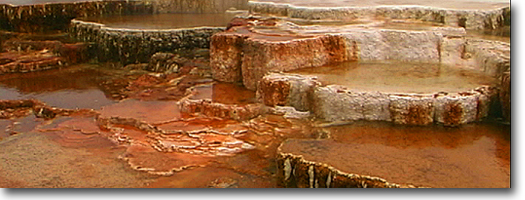
Spring, nearly 370 feet in diameter, sits upon a large mound surrounded
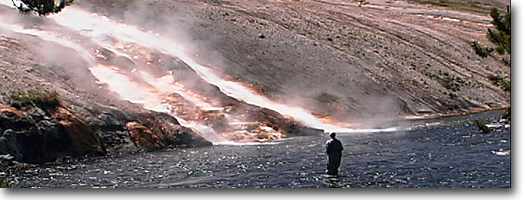
by small step-like terraces. The other feature, Excelsior Geyser, erupted
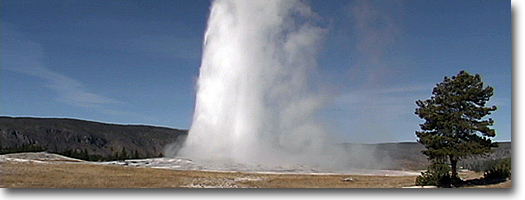
nearly 300 feet high before the 1900s. It is now a dormant geyser and
is considered a hot spring, discharging more than 4050 gallons of boiling
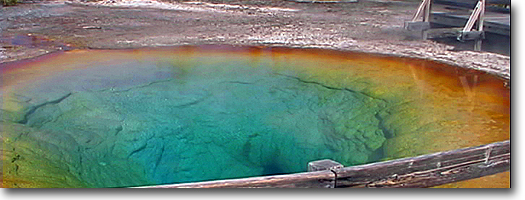
water per minute. Other colorful springs include Turquoise and Indigo
springs, known for their pale and dark blue colors. Across the Firehole
River from Excelsior and Grand Prismatic springs are a series of small
isolated, pristine springs and mud pots. The Rabbit Creek drainage possesses
some colorful and unusual features and most are unnamed. Caution should
be exercised while exploring this vicinity since the ground is unstable
and trails are not maintained.
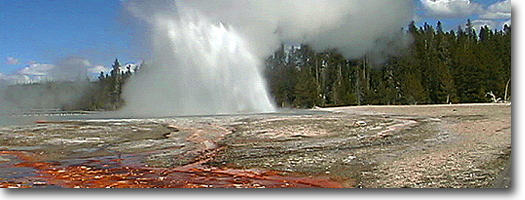
EXCELSIOR GEYSER 
Temperature 199°F Dimensions 276x328 feet. Excelsior was once
the largest geyser In the world. However, the last known major eruptions
occurred during the 1880s, when there were numerous eruptions up to
300 feet. The violent eruptions of the 1880s may have caused damage
to the siliceous sinter lining, allowing gas leakage and the loss of
thermal energy. No observed eruptions were known until 1985 when it
erupted for two days. However, it only obtained a height of 20-80 feet.
Since its eruptive activity in the 1880s, Excelsior is now a productive
thermal spring, presently discharging 4050 gallons per minute. Numerous
vents boil and churn the water within the crater, covering it in a dense
layer of steam.
"The Essenstials for
Planning your
Trip to Yellowstone Park" |
|
|
|
|
GRAND PRISMATIC SPRING 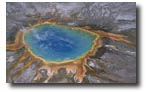
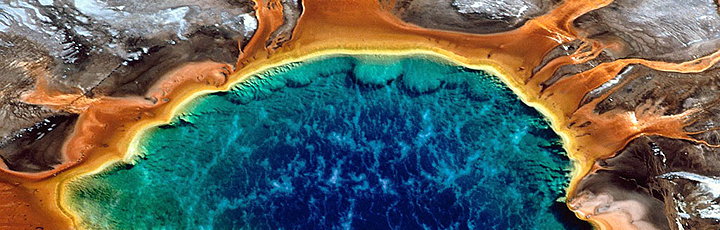
Temperature 147-188°F Dimensions 250x380 feet. Grand Prismatic
is the largest hot spring in Yellowstone, and is considered to be the
third largest in the world-New Zealand has the two largest springs.
Grand Prismatic sits upon a wide, spreading mound where water flows
evenly on all sides forming a series of small, stair-step terraces.
The Hayden Expedition in 1871 named this spring because of its beautiful
coloration, and artist Thomas Moran made water-color sketches depicting
its rainbow-like colors. The sketches seemed exaggerations and geologist
A.C. Peale returned in 1878 to verify the colors. The colors begin with
a deep blue center followed by pale blue. Green algae forms beyond the
shallow edge. Outside the scalloped rim a band of yellow fades into
orange. Red then marks the outer border. Steam often shrouds the spring
which reflects the brilliant colors. Grand Prismatic discharges an estimated
560 gallons per minute.
EXCELSIOR GEYSER
Temperature 199°F Dimensions 276x328 feet. Excelsior was once
the largest geyser in the world. However, the last known major eruptions
occurred during the 1880s, when there were numerous eruptions up to
300 feet. The violent eruptions of the 1880s may have caused damage
to the siliceous sinter lining, allowing gas leakage and the loss of
thermal energy. No observed eruptions were known until 1985 when it
erupted for two days. However, it only obtained a height of 20-80 feet.
Since its eruptive activity in the 1880s, Excelsior is now a productive
thermal spring, presently discharging 4050 gallons per minute. Numerous
vents boil and churn the water within the crater, covering it in a dense
layer of steam.
TURQUOISE POOL 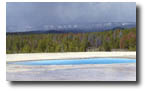
Temperature 142-160°F Dimensions 100x110 feet. The 1878 Hayden
Expedition named this pool for its milky, white bottom and gem-like,
blue-colored water. Suspended mineral particles in the water also add
an opalescent iridescence. Turquoise has no apparent overflow channel,
instead water drains through seepage. There is an underground connection
with Excelsior Geyser. When Excelsior was active, Turquoise lowered
nearly ten feet and took nearly a year to recover. In June and July
purple fringed gentians are common and bloom on the barren ground surrounding
this pool.
|